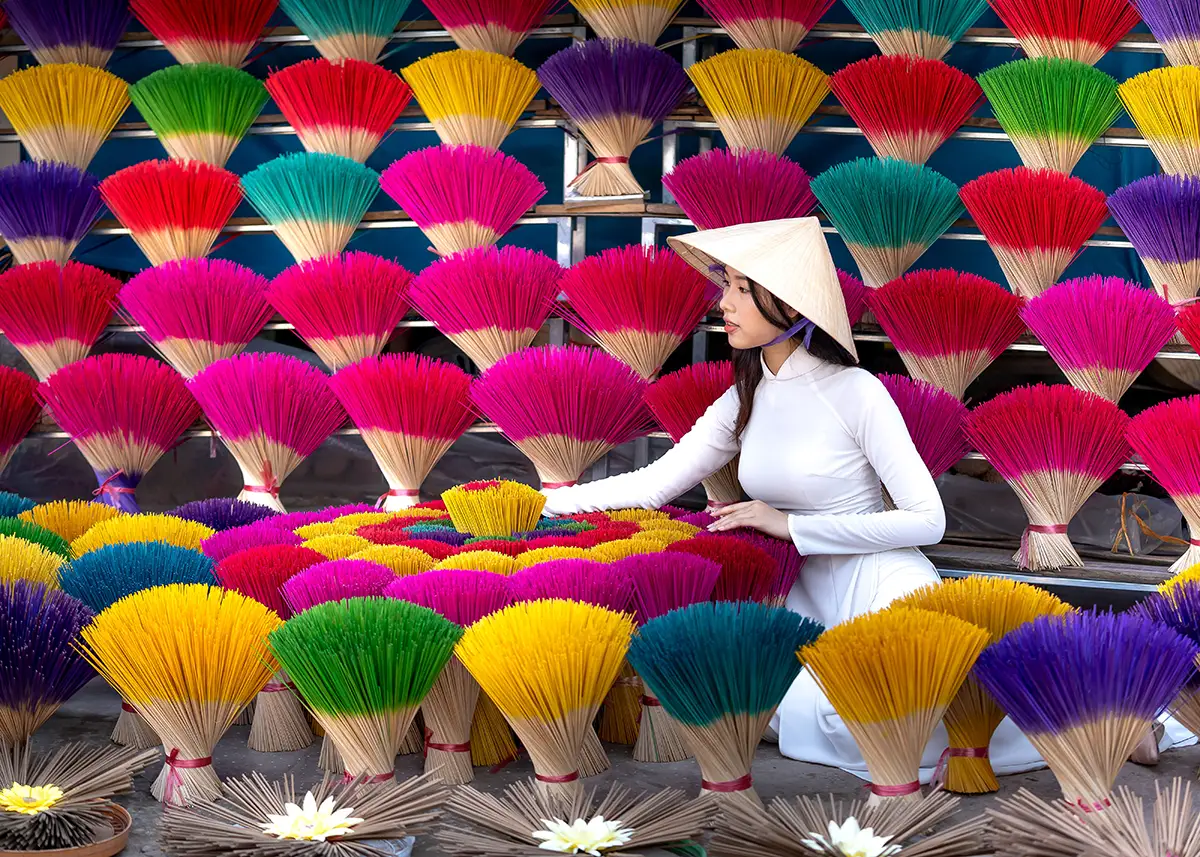
Just outside the busy streets of Hanoi lies a traditional craft village where thousands of colorful incense sticks are arranged under the sun like giant bouquets. Quang Phu Cau incense village is one of the most photogenic cultural destinations near the Vietnamese capital, but its appeal goes far beyond beautiful photographs.
For generations, local families in Quang Phu Cau have preserved the traditional craft of making incense, from preparing bamboo sticks and dyeing them to mixing fragrant powders and carefully drying the finished products. Today, visitors can experience this living craft tradition while exploring a peaceful rural community only a short journey from Hanoi.
This guide explains everything you need to know before visiting, including the history of Quang Phu Cau village, what you can see and do, how to get there, the Quang Phu Cau entrance fee, the best time to visit, and practical tips for making your trip both enjoyable and respectful.
Quick Visitor Guide
- Location: Quang Phu Cau Incense Village, Ung Thien Commune, Hanoi
- Distance from Hanoi Old Quarter: Approximately 35–40 km
- Typical travel time: Around 1–1.5 hours, depending on traffic
- Recommended visit: 2–3 hours
- Official village entrance fee: No general entrance fee
- Photography areas: Some private drying yards may charge 50,000 VND
- Best photography time: Early morning or late afternoon
- Best season: Dry, sunny periods and the busy production season before Tet
What Is Quang Phu Cau Incense Village?
Quang Phu Cau incense village is a traditional craft community in the southern outskirts of Hanoi, well known for producing incense used in Vietnamese religious and cultural practices.
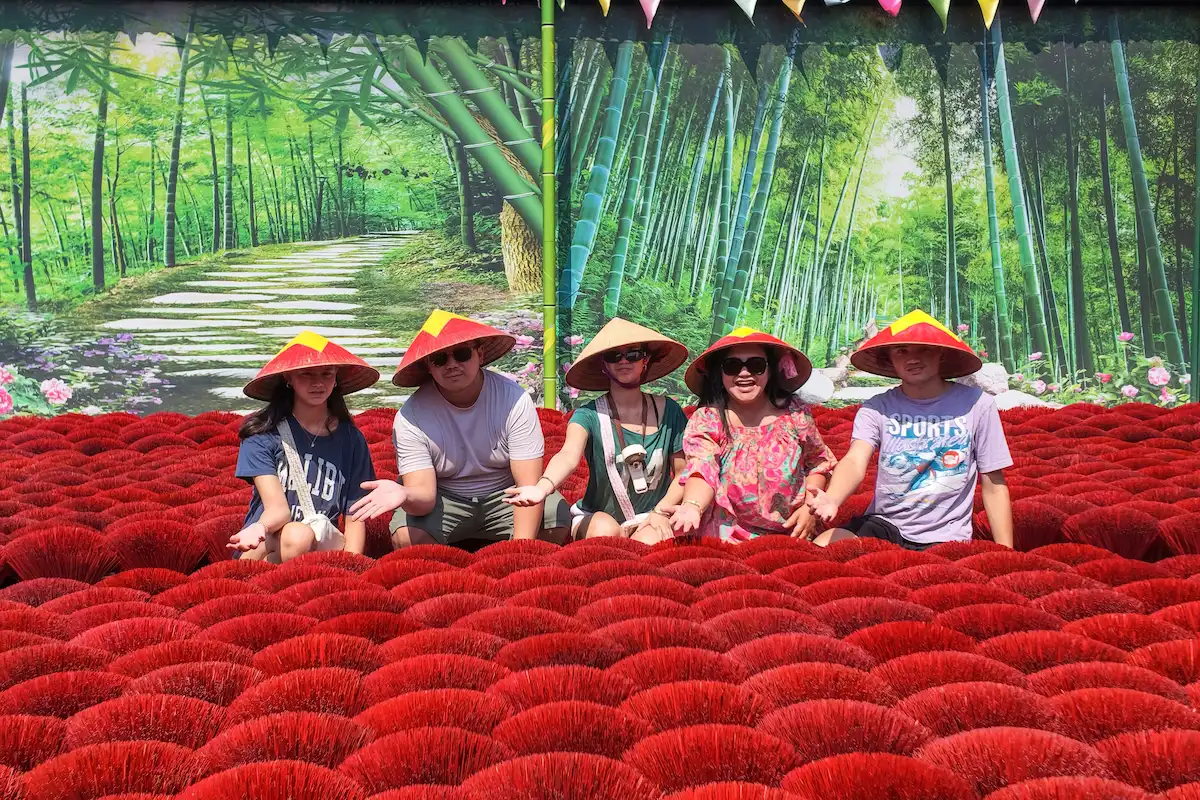
The village is particularly famous for the colorful bundles of incense sticks that are spread out to dry in courtyards, along village roads, and around family workshops. Red is the dominant color, although visitors may also see other colors depending on the production process and the products being prepared.
What makes the village especially interesting is that incense production is not simply a demonstration created for tourists. It remains part of the local economy and everyday life. As you walk through the village, you may see workers splitting bamboo, preparing incense sticks, dyeing their ends, mixing fragrant materials, or arranging finished sticks for drying.
This combination of traditional craftsmanship and everyday village life gives Quang Phu Cau a character that is very different from a conventional tourist attraction.
A Traditional Craft With More Than a Century of History
The incense-making tradition in Quang Phu Cau has been preserved for more than a century and has gradually expanded from individual villages within the commune into a wider production area. The craft has been passed from one generation to the next, with families developing their own skills and methods while adapting to changing demand.
Incense plays an important role in Vietnamese spiritual life. It is commonly burned at family altars, temples, pagodas, and during traditional ceremonies as an expression of respect and remembrance.
For this reason, visiting Quang Phu Cau is not simply about seeing colorful incense bundles. It provides an opportunity to understand how a traditional handicraft remains connected to Vietnamese family traditions, religious customs, and rural livelihoods.
How Is Incense Made in Quang Phu Cau?
One of the most interesting parts of a Quang Phu Cau incense village tour is seeing the production process up close.
1. Preparing the Bamboo Sticks
Bamboo is processed into thin sticks that form the base of the incense. Workers carefully cut and prepare the bamboo before it moves to the next stage of production.
2. Dyeing the Incense Sticks
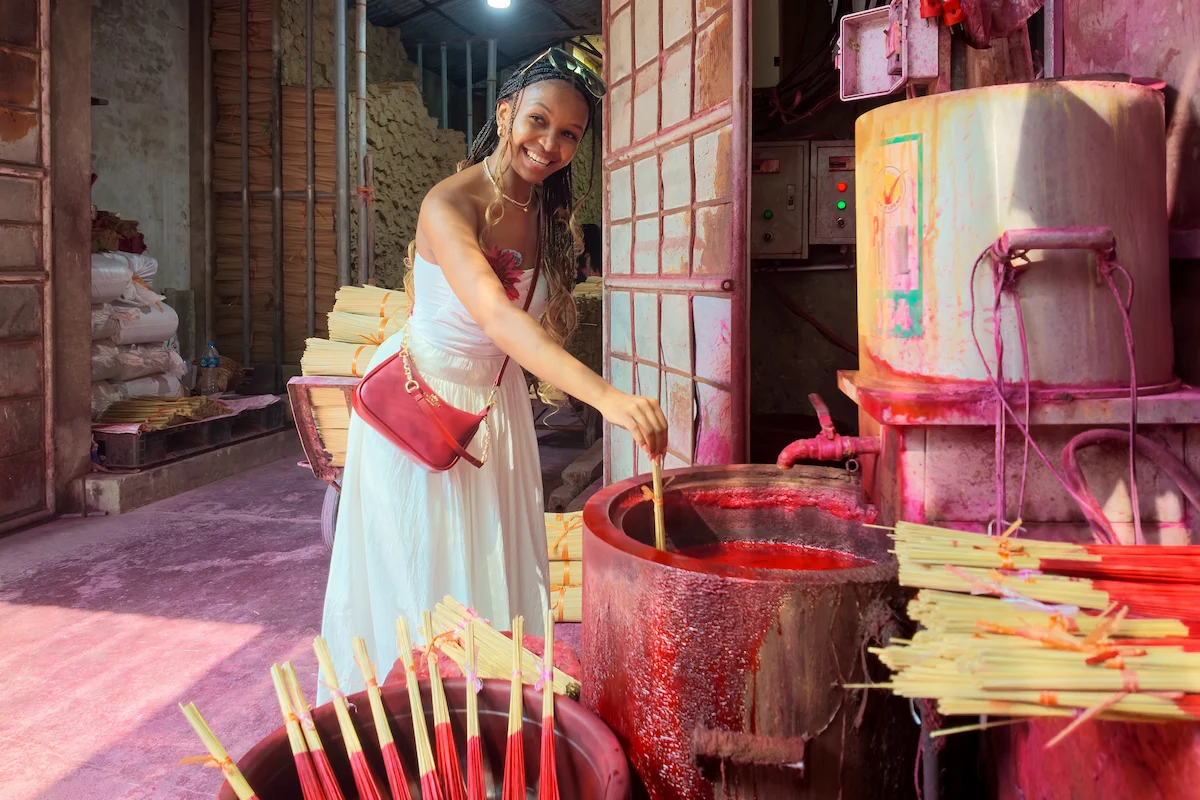
The lower part of the bamboo sticks is traditionally dyed, creating the bright red color that has become the visual symbol of the village. Depending on the product, other colors may also be used.
3. Applying the Fragrant Material
The prepared sticks are coated with a mixture of fragrant materials. Different producers may use different recipes and proportions, which contribute to variations in scent and appearance.
4. Drying the Incense
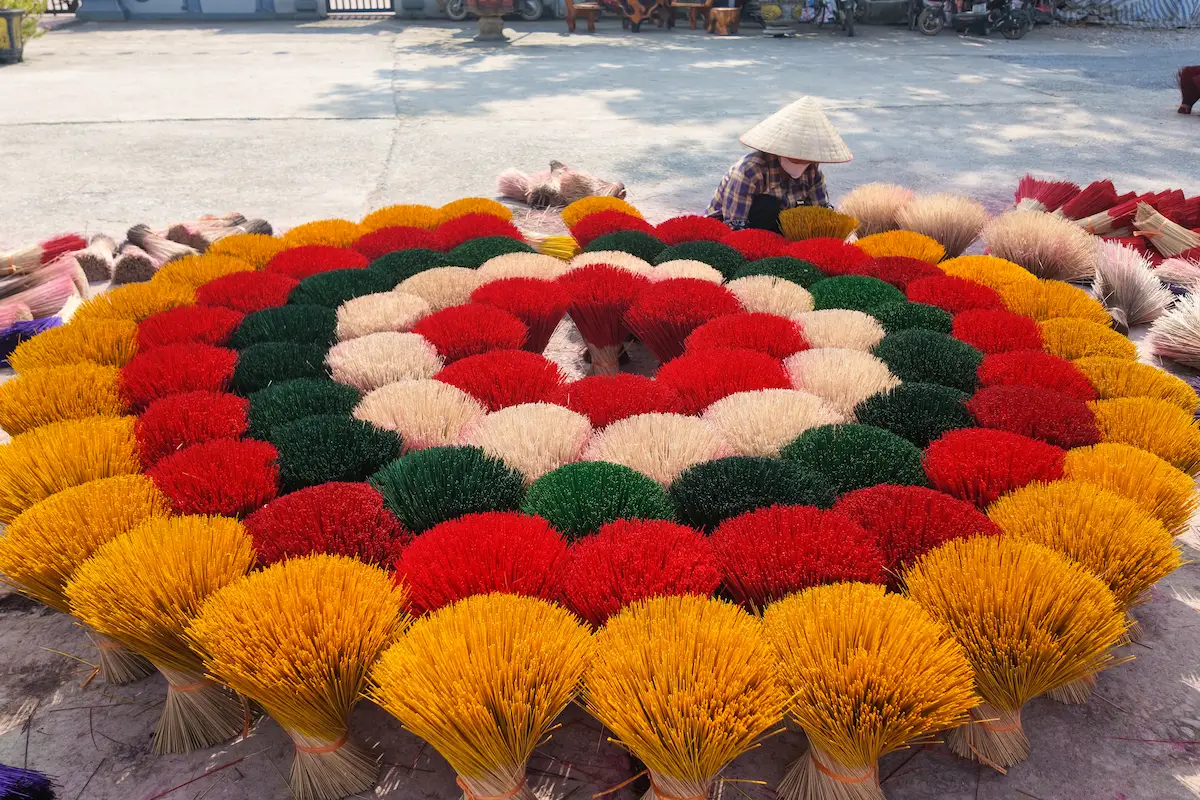
The finished sticks are arranged into large bundles and spread out in the sun. This is the stage that creates the spectacular scenes visitors associate with incense village Hanoi.
When hundreds or thousands of sticks are arranged in circular or fan-shaped patterns, the drying yards can look almost like enormous flowers. The visual effect becomes particularly striking when sunlight falls directly across the red incense.
What Can You Do at Quang Phu Cau?
See the Traditional Incense-Making Process
Take time to look beyond the colorful drying yards. Inside and around local workshops, you may see different stages of production taking place simultaneously. Watching the artisans work helps explain how much manual skill is hidden behind the beautiful images seen online.
Explore the Village and Its Rural Surroundings
Quang Phu Cau is more than a collection of photography yards. Walking through the surrounding streets gives you a glimpse of suburban Hanoi and the quieter rhythm of village life.
Depending on the day and season, you may see workers transporting bamboo, preparing incense, drying materials, or packaging finished products. The atmosphere is particularly lively when production increases ahead of the Lunar New Year.
Learn About the Cultural Meaning of Incense
For Vietnamese families, incense is closely associated with remembrance, respect, prayer, and traditional ceremonies. Understanding this cultural context makes a visit much more meaningful than simply photographing colorful bundles.
Even if you are not familiar with Vietnamese religious traditions, a local guide can help explain why incense remains such an important part of everyday cultural life.
Quang Phu Cau Incense Village Hanoi: How to Get There
If you are wondering how to get to Quang Phu Cau incense village, there are several options from Hanoi. The village is approximately 35–40 km from the city center, so the journey usually takes around one to one and a half hours depending on traffic.
By Private Car or Taxi
A private car is the most comfortable option, especially for families, photographers carrying equipment, or travelers who want to combine the village with other attractions outside Hanoi.
Ride-hailing services and taxis can also be used, although arranging a return journey in advance is advisable because Quang Phu Cau is outside central Hanoi.
By Motorbike
Experienced riders can reach the village by motorbike, offering greater flexibility to explore the surrounding countryside. The route generally follows National Highway 21B and local roads toward Quang Phu Cau.
However, international visitors should be comfortable with Vietnamese traffic conditions before choosing this option. Traffic can become considerably heavier around Hanoi during peak hours.
By Public Bus
Public buses are a possible option, but they are not the most convenient choice for international visitors staying in Hanoi’s Old Quarter.
Bus 91 operates from Yen Nghia Bus Station in Ha Dong, which is approximately 10 km from Hanoi’s Old Quarter. This means travelers staying in the city center first need to make their way to Yen Nghia Bus Station before taking the bus toward the Quang Phu Cau area.
For Vietnamese travelers familiar with the local bus system, this can be a budget-friendly option. After getting off the bus near the village, you may need to ask local residents for directions or take a xe om (motorbike taxi) for the remaining distance to the incense-making area.
For international visitors, however, this option can be considerably more complicated. Finding the correct bus from the Old Quarter, communicating with the driver, identifying the appropriate stop, and arranging the final transfer to the village can take time and may be stressful, especially for first-time visitors to Hanoi.
If you are staying in the Hanoi Old Quarter, a private car, taxi, or organized Quang Phu Cau incense village tour is generally a much more convenient option. These choices allow you to travel directly from your hotel to the village without having to change transportation or navigate the final rural section on your own.
Our Recommendation for International Visitors
If you are staying around Hanoi’s Old Quarter, we recommend choosing a private car, taxi, or guided tour rather than relying on public buses. The additional cost is usually worthwhile for the convenience, especially if you are traveling with photography equipment or planning to combine Quang Phu Cau with other attractions outside Hanoi.
For first-time visitors who want to focus on the cultural experience rather than transportation logistics, a guided Quang Phu Cau incense village tour can be the simplest option. A tour can also make it easier to communicate with local artisans and understand the incense-making process.
Quang Phu Cau Entrance Fee: What Should You Expect?
There is no general official entrance fee for the village itself. Quang Phu Cau is a working community rather than a single enclosed attraction with one ticket gate.
However, some family-run workshops and private drying yards have created dedicated spaces for visitors and photographers. These locations may charge a small photography or access fee, commonly around 50,000 VND per person.
These private areas can offer particularly photogenic arrangements of incense, elevated viewpoints, or more space for photography. Rather than thinking of the fee as simply an entrance charge, it is better understood as a contribution to the families maintaining these visitor-friendly spaces.
Always confirm the price before entering a private yard, and ask permission before photographing workers or entering areas that are not clearly open to visitors.
Important Photography Etiquette
The most beautiful photography locations are often part of someone’s home, workshop, or working area. Do not move incense bundles, walk through drying areas without permission, or interrupt artisans while they are working. A polite request and a small photography fee can help create a much more positive experience for both visitors and local families.
Best Time to Visit Quang Phu Cau
Quang Phu Cau can be visited throughout much of the year, but weather and production schedules can make a significant difference to your experience.
Dry and Sunny Days
Sunshine is particularly important because incense sticks need to be dried naturally. On a bright day, the red bundles stand out dramatically against the sky and surrounding countryside, creating much stronger photographs than on a cloudy or rainy day.
Before the Lunar New Year
The weeks leading up to Tet, Vietnam’s Lunar New Year, are among the busiest periods for incense production. Demand increases as families prepare for traditional celebrations, creating a more energetic working atmosphere throughout the village.
This period can be especially rewarding for travelers interested in seeing the craft in action rather than visiting only for photography. However, production areas can also be busier, so visitors should be especially careful not to interfere with the workers.
Best Time of Day for a Visit
For photography, early morning and late afternoon are generally the most attractive times. Softer sunlight creates more texture and dimension in the incense bundles, while the lower angle of the sun can produce warm highlights and shadows.
Midday can still be worthwhile on a sunny day, but the light is usually much harsher. If photography is your main priority, planning your visit around the morning or late afternoon will give you more creative possibilities.
Best Photo Spots & Angle Guide in Quang Phu Cau
For photography lovers, Quang Phu Cau incense village offers far more than one classic “sea of red incense” photograph. The most interesting images come from changing your position, focal length, height, and relationship with the people and surroundings.
The key is to photograph the village as a living craft community rather than simply treating the incense bundles as a colorful backdrop. Look for layers, patterns, human activity, traditional tools, village roads, and the contrast between the bright incense and the quieter countryside.
1. The Circular Incense Drying Yards
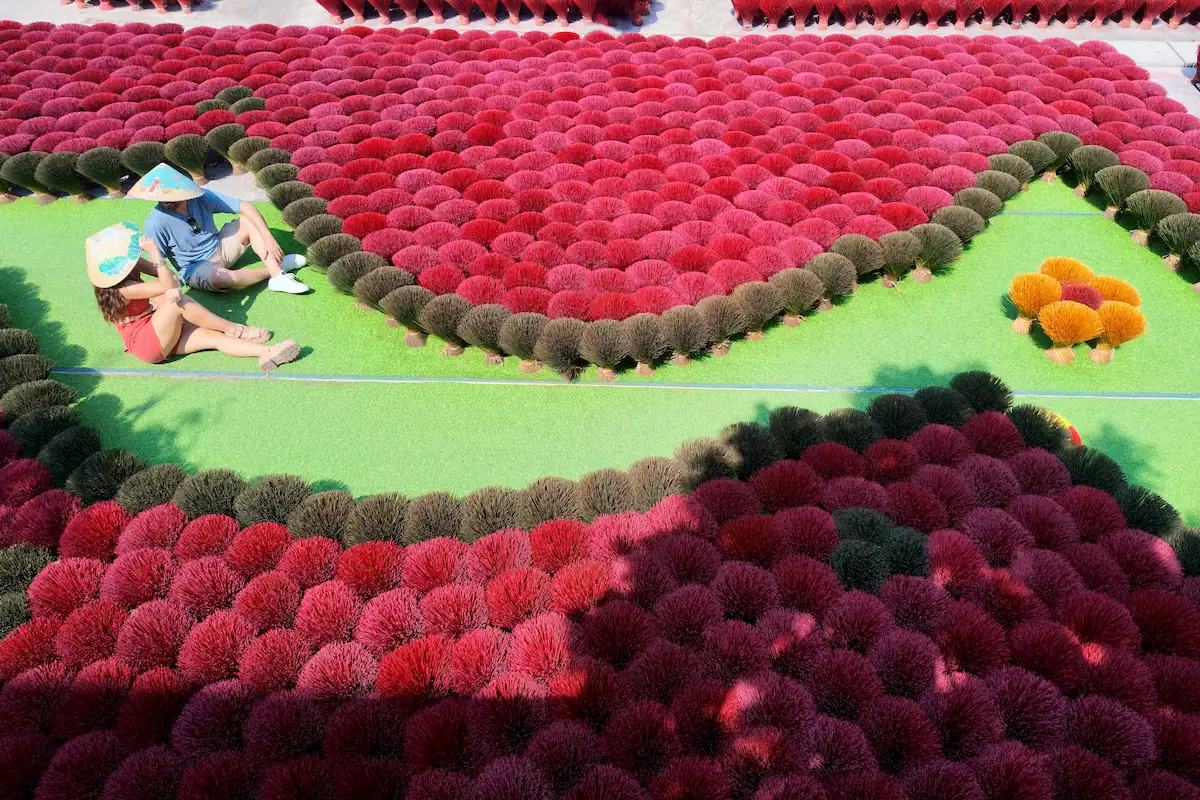
The large drying yards are the most recognizable Quang Phu Cau incense village photo spots. Workers arrange bundles of incense sticks in circular, fan-shaped, or radial patterns, creating compositions that resemble enormous flowers when photographed from above.
For a classic image, stand at ground level and use the rows of incense as leading lines toward the center of the arrangement. A slightly lower camera position can make the bundles appear larger and more dramatic.
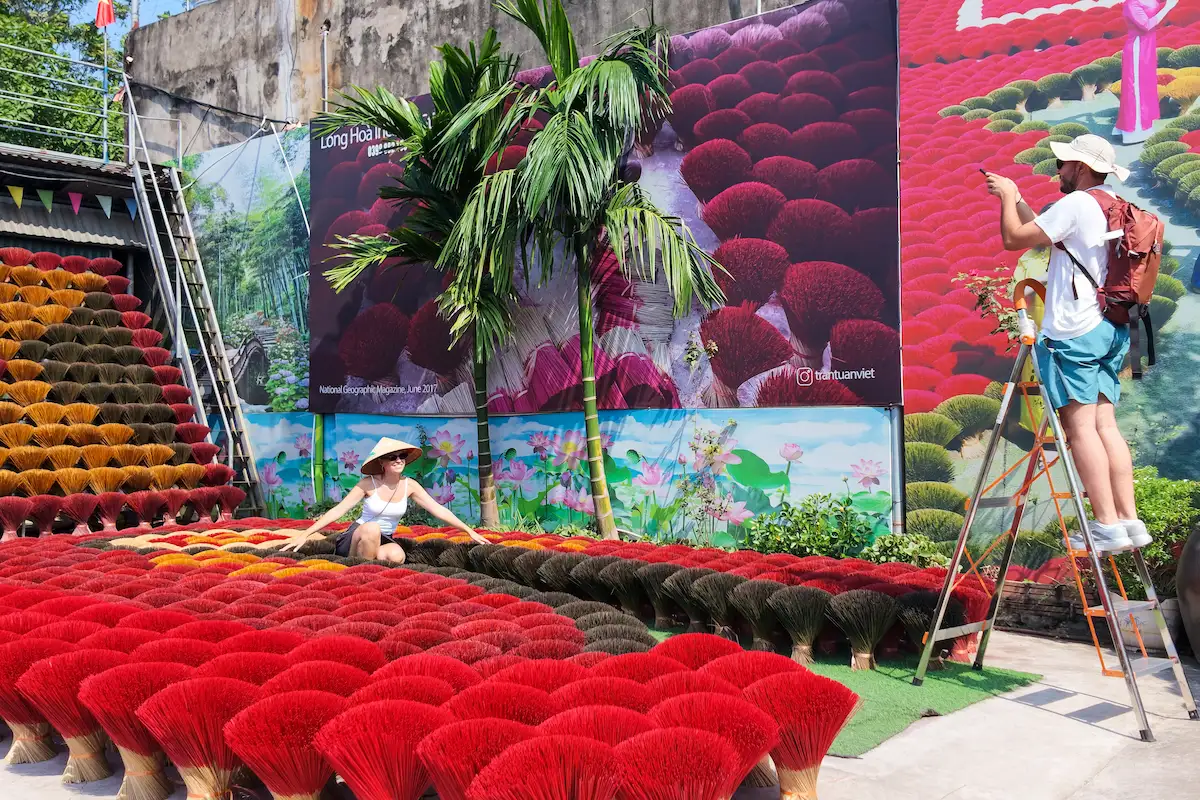
If the yard has an elevated wooden platform or ladder, ask permission before using it. From a higher position, the geometric patterns become much easier to see and the composition becomes more graphic.
2. The Elevated Viewpoint
One of the best photo spots in Quang Phu Cau incense village is an elevated platform inside a private drying yard. These platforms allow photographers to look down onto the incense arrangements without needing a drone.
A top-down or high-angle photograph can reveal the complete circular pattern, while a diagonal angle creates depth by showing several layers of incense bundles at different distances.
If you are traveling with a smartphone, this is also one of the easiest ways to achieve a strong composition without specialist equipment.
3. Workers Preparing the Incense
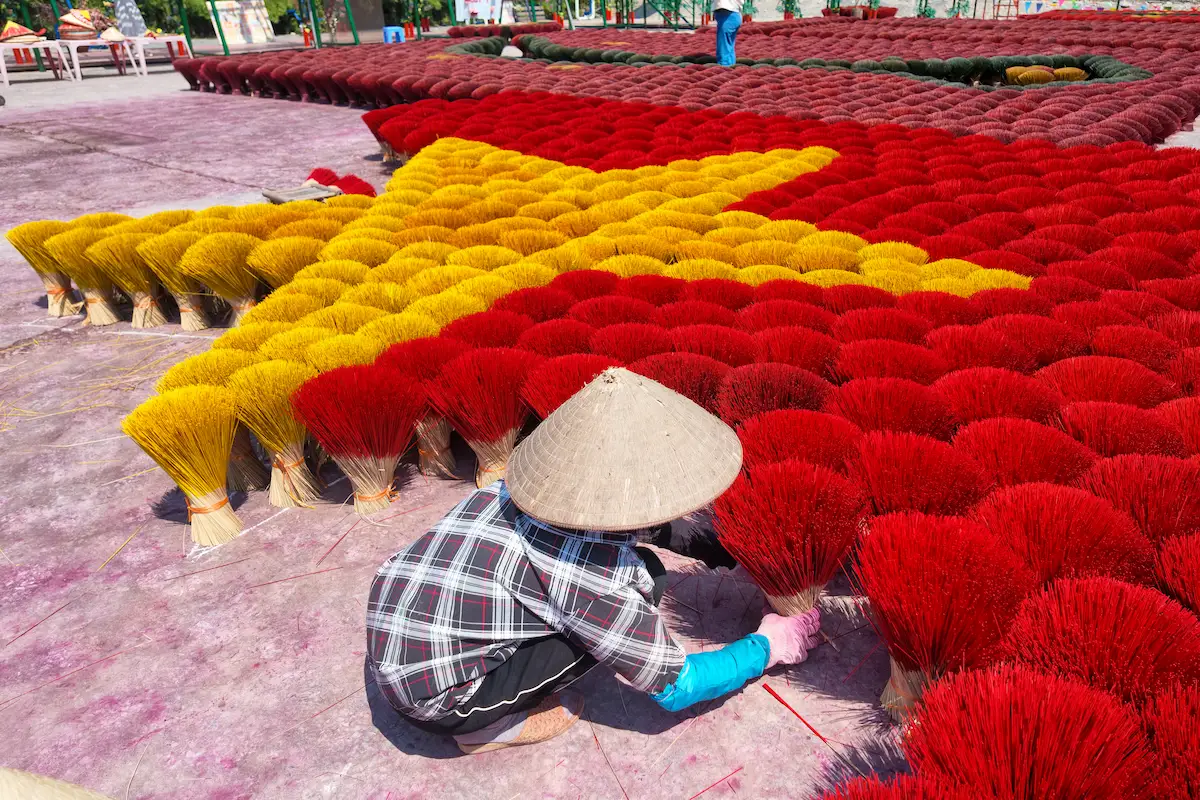
Do not spend your entire visit photographing finished products. Some of the most meaningful images are found where artisans are preparing bamboo sticks, dyeing the incense, applying fragrant material, or arranging bundles for drying.
Use a medium or telephoto lens to photograph these activities from a respectful distance. Place the worker slightly off-center and allow the surrounding workshop, bamboo, tools, and incense to tell the story.
Always ask permission before taking close-up portraits. The best photographs often come naturally when people are concentrating on their work rather than posing for the camera.
4. Village Lanes and Everyday Life
Walk beyond the main photography yards and look for quieter scenes. Narrow village roads, bicycles, houses, bamboo materials, workers carrying bundles, and incense drying beside everyday buildings can create more documentary-style photographs.
These images are particularly useful if you want your travel story to communicate what Quang Phu Cau village is actually like rather than presenting only the most carefully arranged tourist photographs.
5. Incense Against the Sky
On a bright day, try photographing the incense bundles against an open blue sky. Position yourself low and use the incense as the dominant foreground subject.
This technique works particularly well when the bundles are tall and densely packed. The strong contrast between red incense and blue sky creates a simple composition that works beautifully for both horizontal travel photographs and vertical social media images.
6. Detail and Texture Shots
Move closer and photograph individual incense sticks, bamboo textures, hands at work, bundles tied together, and the powder used in the production process.
Close-up images can add variety to your photo collection and help tell the complete story of how incense is produced. A macro or telephoto lens is ideal, but modern smartphones can also produce excellent detail photographs in good daylight.
Drone Photography at Quang Phu Cau Incense Village
Drone photography at Quang Phu Cau incense village can produce spectacular top-down images because of the geometric patterns created by the drying incense. However, drone users need to be much more careful than ordinary visitors.
Do not assume that because a location is visually attractive, flying a drone is automatically permitted. Vietnamese drone operations are subject to aviation regulations, and local restrictions or permissions may apply. Check the current rules and any required authorization before bringing a drone into the area.
Even when flying is permitted, never operate directly above workers, crowded yards, houses, vehicles, or other people’s private property. A drone should never interfere with the production process or create a safety risk.
For many visitors, an elevated platform inside a photography yard is a safer and simpler alternative. It can produce a very similar top-down composition without the regulatory and safety concerns associated with aerial photography.
Portrait Photography at Quang Phu Cau
Portrait photography at Quang Phu Cau incense village works especially well because the vivid red incense creates a strong visual background. However, the best portraits are those that respect the character of the location rather than turning the village into a staged studio.
What to Wear
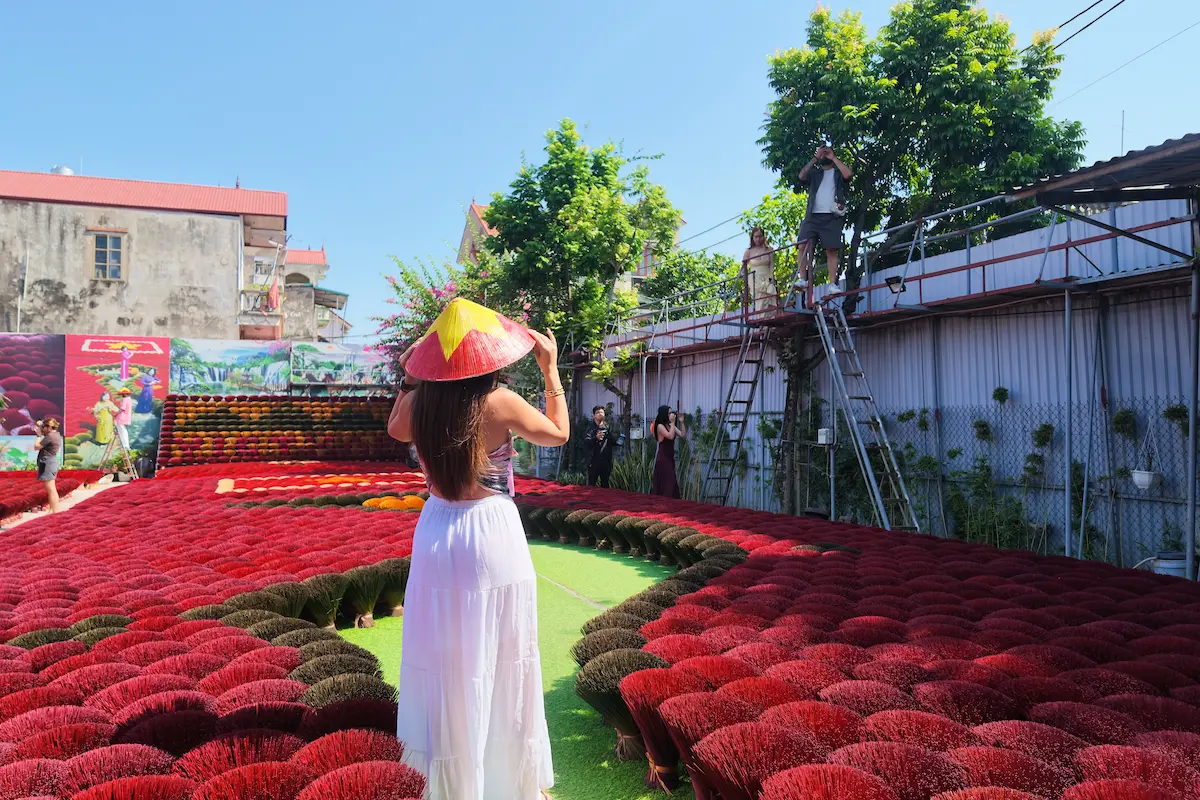
Light-colored clothing usually contrasts strongly with the red incense. White, cream, yellow, light blue, or traditional Vietnamese clothing can create attractive color combinations.
If you want a stronger cultural connection, an Ao Dai can work beautifully, but avoid overly elaborate styling that makes the photograph feel disconnected from the working environment.
Quang Phu Cau Incense Village Pose Ideas
- Stand between two rows of incense and look toward the camera.
- Walk slowly along the edge of a drying yard for a natural movement shot.
- Hold a small bundle of incense while looking away from the camera.
- Stand in the center of a circular arrangement for a high-angle portrait.
- Use the incense bundles as foreground elements and photograph through them.
- Try a simple side profile with the drying yard filling the background.
Avoid touching or rearranging the incense simply to improve a photograph. The bundles are part of someone’s work, and keeping the original arrangement intact is more respectful and often produces more authentic images anyway.
Best Time of Day to Take Photos at Quang Phu Cau
The best time of day to take photos at Quang Phu Cau depends on the type of image you want.
Early Morning: Around 7:00–9:00 AM
Early morning offers cooler temperatures, softer light, and a quieter atmosphere. This is particularly attractive for portraits, documentary photography, and photographs that include workers beginning their day.
However, arriving extremely early does not guarantee that incense will already be spread out. Drying depends on weather and the production schedule, so sunny conditions are more important than simply arriving at sunrise.
Morning: Around 9:00–11:00 AM
This can be an excellent compromise between attractive light and active village life. On suitable production days, more incense may be visible in the drying yards and you may have a better chance of seeing artisans working.
Late Afternoon: Around 3:00–5:00 PM
Late afternoon brings warmer light and longer shadows. The sunlight can emphasize the texture of the incense bundles and produce a richer, more atmospheric image.
For dramatic photography, this is one of the most rewarding periods of the day, provided the weather remains clear.
How to Photograph Quang Phu Cau Responsibly
The most important photography rule is simple: remember that this is a working village, not a theme park.
- Ask permission before entering private drying yards.
- Confirm any photography fee before entering.
- Do not step on, move, or rearrange incense bundles.
- Never block workers or production areas for a photograph.
- Ask before taking close-up portraits of local people.
- Do not fly a drone without confirming that it is legally permitted.
- Be especially careful around bamboo, equipment, vehicles, and drying materials.
Following these simple rules allows photographers to enjoy the village while helping local families continue their traditional work without unnecessary disruption.
How Long Should You Spend at Quang Phu Cau?
For most independent travelers, around 2–3 hours is enough to visit a photography yard, observe the production process, walk through parts of the village, and take a good selection of photographs.
Photography enthusiasts may want to stay longer, particularly if they are waiting for specific lighting conditions or hoping to photograph different stages of incense production.
If you are traveling from Hanoi, combining Quang Phu Cau with other cultural attractions can make the journey more worthwhile. Quang Phu Cau can also be included as part of a longer Northern Vietnam experience, such as our Ninh Binh Culture & Nature Escape 2 Days 1 Night, which visits Quang Phu Cau on Day 1 before continuing to explore Ninh Binh’s cultural heritage and natural landscapes.
Is Quang Phu Cau Incense Village Worth Visiting?
Yes, especially if you are interested in photography, traditional crafts, Vietnamese culture, or experiences beyond Hanoi’s major tourist attractions.
The village is not a conventional sightseeing destination with a large museum or a long list of monuments. Its appeal comes from watching a traditional craft continue in a real working community and seeing how ordinary production becomes visually extraordinary when thousands of incense sticks are arranged to dry under the sun.
For photographers, the combination of vivid colors, geometric patterns, human stories, and rural surroundings makes Quang Phu Cau incense village one of the most distinctive day trips from Hanoi.
Planning Your Quang Phu Cau Visit?
A guided Quang Phu Cau incense village tour can be a convenient option if you want to understand the incense-making process, communicate with local artisans, and visit the most photogenic areas without worrying about transportation from Hanoi.
For photographers, having a local guide can also make it easier to ask permission, identify suitable photography locations, and understand when the incense is being prepared and dried.
Combine Quang Phu Cau with other cultural experiences around Hanoi for a deeper look at Vietnam beyond the usual tourist attractions.
Frequently Asked Questions
1. Is there an entrance fee for Quang Phu Cau incense village?
There is no general entrance fee for walking through the public parts of the village. However, some private workshops and drying yards charge approximately 50,000–100,000 VND per person for photography access. Prices can vary, so confirm the fee before entering.
2. What is the best time to visit Quang Phu Cau?
Sunny days are generally best because incense is spread outside to dry. For photography, early morning and late afternoon provide softer, more attractive light. The weeks before Tet are particularly interesting because incense production becomes much busier, although the village can also be more crowded.
3. Can I take drone photos at Quang Phu Cau?
Drone photography can create excellent top-down images, but you should not fly without first checking current Vietnamese aviation requirements and local restrictions. Never fly over workers, crowded areas, private homes, or active production spaces.
4. How far is Quang Phu Cau from Hanoi?
Quang Phu Cau is approximately 35–40 km from central Hanoi. By private car or taxi, the journey usually takes around one to one and a half hours, depending on traffic. Public transport is possible but takes more planning.
5. How long do I need at Quang Phu Cau incense village?
Allow around 2–3 hours for a first visit. This gives you enough time to photograph the drying yards, observe incense production, walk through part of the village, and experience the local atmosphere without rushing.
Final Thoughts
Quang Phu Cau incense village offers a rare combination of traditional craftsmanship, rural life, and extraordinary visual beauty just outside Hanoi. The famous red incense fields may be what first attracts visitors, but the real value of the experience lies in understanding the people and traditional work behind those photographs.
Visit on a dry, sunny day, allow enough time to explore beyond the main photography yards, and treat every workshop as someone’s workplace. With the right approach, a trip to this incense village in Hanoi can become much more than a photo stop—it can be a memorable introduction to one of Northern Vietnam’s enduring craft traditions.