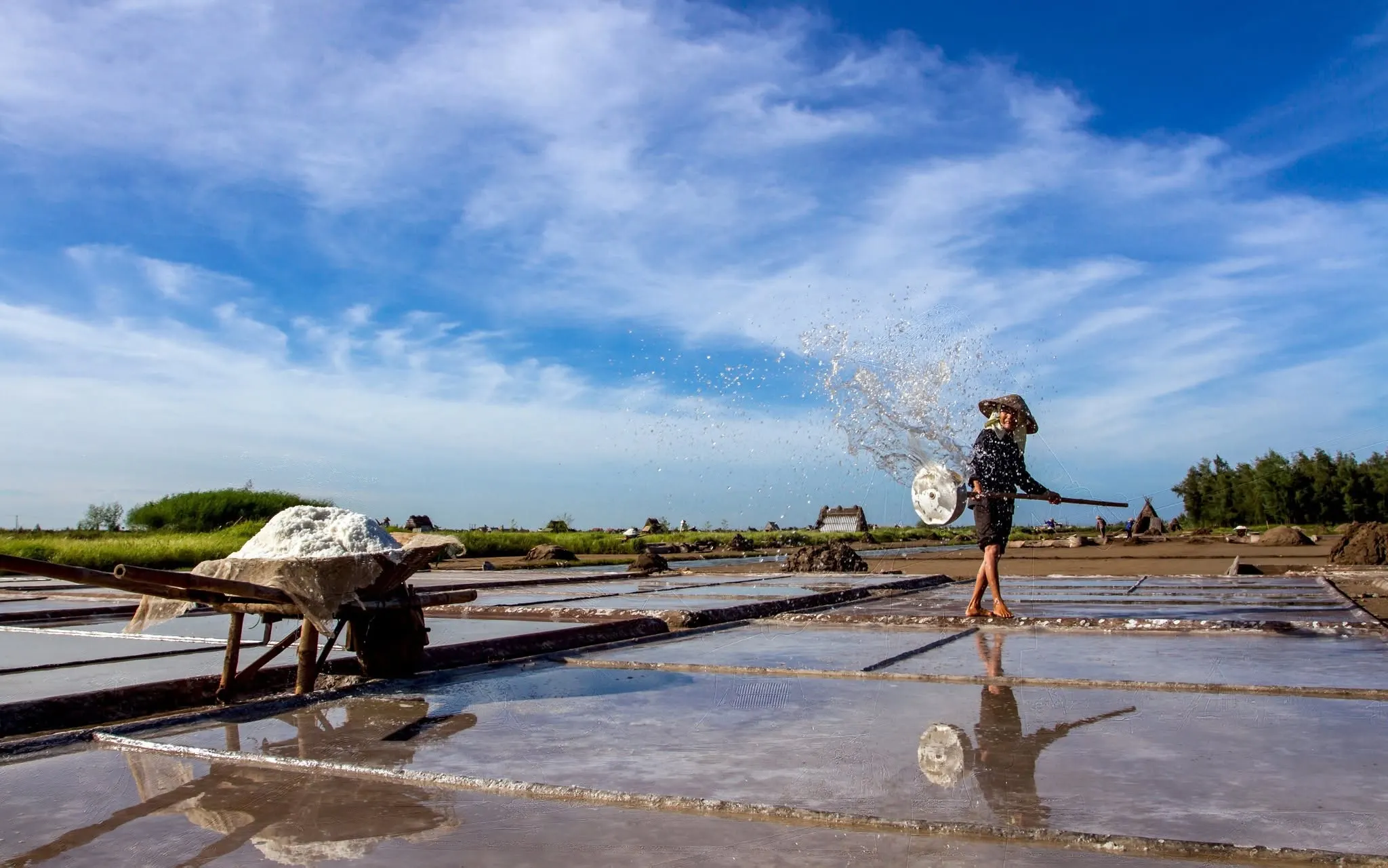
Imagine arriving at a coastal field just after sunrise, when the first light turns hundreds of shallow plots into silver mirrors. There are no resort buildings or crowds here. Instead, you hear carts rolling across narrow paths, tools scraping the earth, and salt farmers beginning another long day under the sun. This is Bach Long salt field, a traditional coastal landscape in northern Vietnam where salt is still produced using methods passed from one generation to the next. For travelers interested in local culture, photography, sustainable tourism, and everyday Vietnamese life, a visit offers something far more meaningful than a scenic stop: a chance to understand how sea, soil, weather, and human labor become something as ordinary and precious as salt.
At a glance: Bach Long is a traditional salt-making area in Giao Thuy, now part of Ninh Binh Province (formerly in Nam Dinh Province). The main production season generally runs from March to August, depending heavily on sunshine and weather.
A Salt-Making Tradition Shaped by the Sea
Location
The coastal commune of Bach Long has long been associated with salt production. At its historical peak, the salt fields covered around 230 hectares and supported thousands of people, making Bach Long one of the best-known salt-producing areas in northern Vietnam. The craft became deeply connected with the development of the local community, and the salt fields evolved into much more than agricultural land: they became part of the cultural landscape and identity of the coastal villages.
Yet salt farming in Vietnam is not simply a story of tradition surviving unchanged. It is also a story of economic pressure and adaptation. Reports from recent years show that the area under salt production in Bach Long has declined significantly, with many younger residents seeking other occupations and much of the traditional work increasingly carried out by older farmers and women.
This makes the experience especially valuable for visitors. A salt field is easy to photograph, but understanding the people who continue working there gives the landscape a much deeper meaning.
The human story behind every grain
Salt-making depends on a combination of things that farmers cannot fully control: sunshine, wind, rain, tides, and the availability of labor. A long period of rain can interrupt production, while strong sunshine can transform seawater into valuable salt much more quickly.
Why Bach Long Uses Sand to Make Salt
What makes Bach Long salt field particularly interesting to foreign visitors is its traditional sand-drying technique. Unlike salt production systems where seawater is simply evaporated in large ponds, farmers here have traditionally used layers of sand as part of the process.
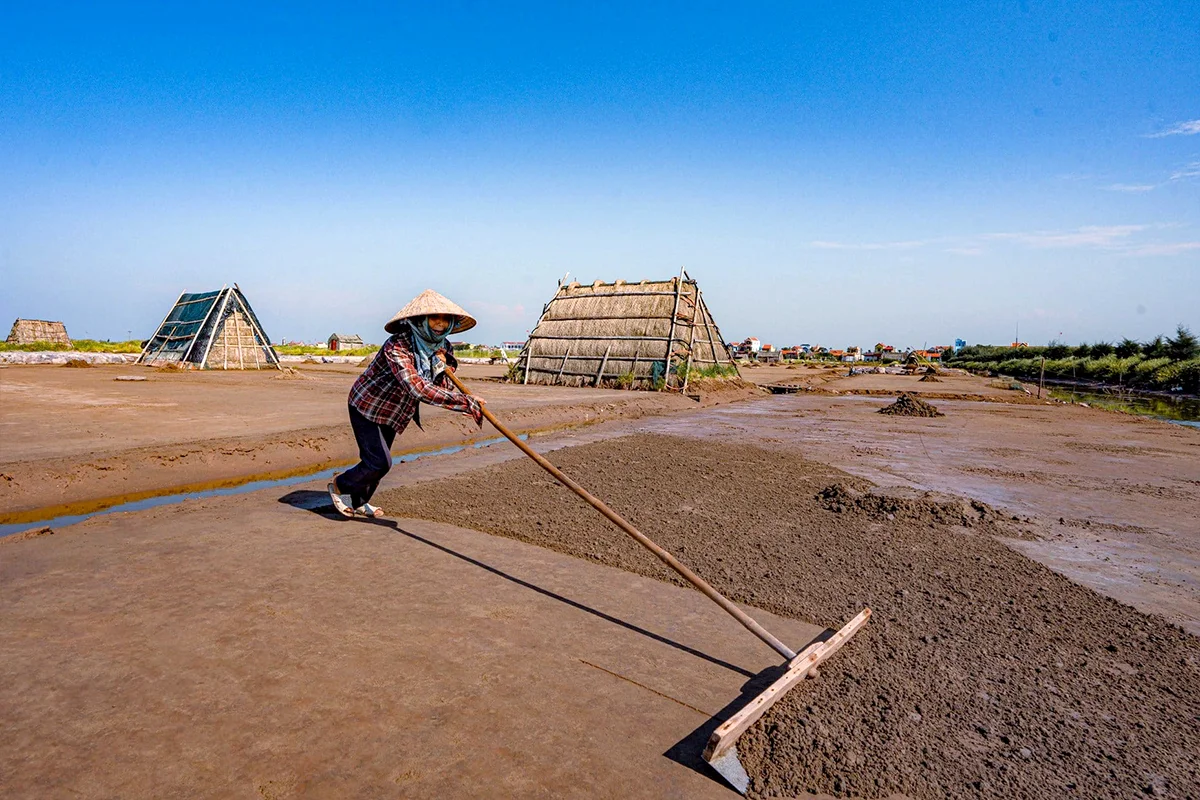
The basic principle is surprisingly simple, but the work is physically demanding. Seawater is brought into the salt-producing area and used to wet carefully prepared layers of sand. The sand is then exposed to the sun so that water evaporates and salt concentration increases. Farmers rake and collect the salt-laden sand before washing or filtering it to obtain concentrated brine, which is then evaporated again until salt crystals form.
The technique requires patience and repeated manual work. Farmers have to prepare the ground, move water, spread and rake sand, collect material, filter it, and finally harvest the salt. The process is closely linked to weather: strong sunshine is essential, while rain can quickly disrupt the day’s work.
For travelers accustomed to seeing salt as a finished product in a supermarket, watching this process can change the way they think about one of the most basic ingredients in everyday life.
A Day in the Salt Fields
During the main season, salt farmers may begin work very early in the morning and continue into the late afternoon. The timing is dictated by the weather and the stages of production rather than by a fixed tourist schedule.
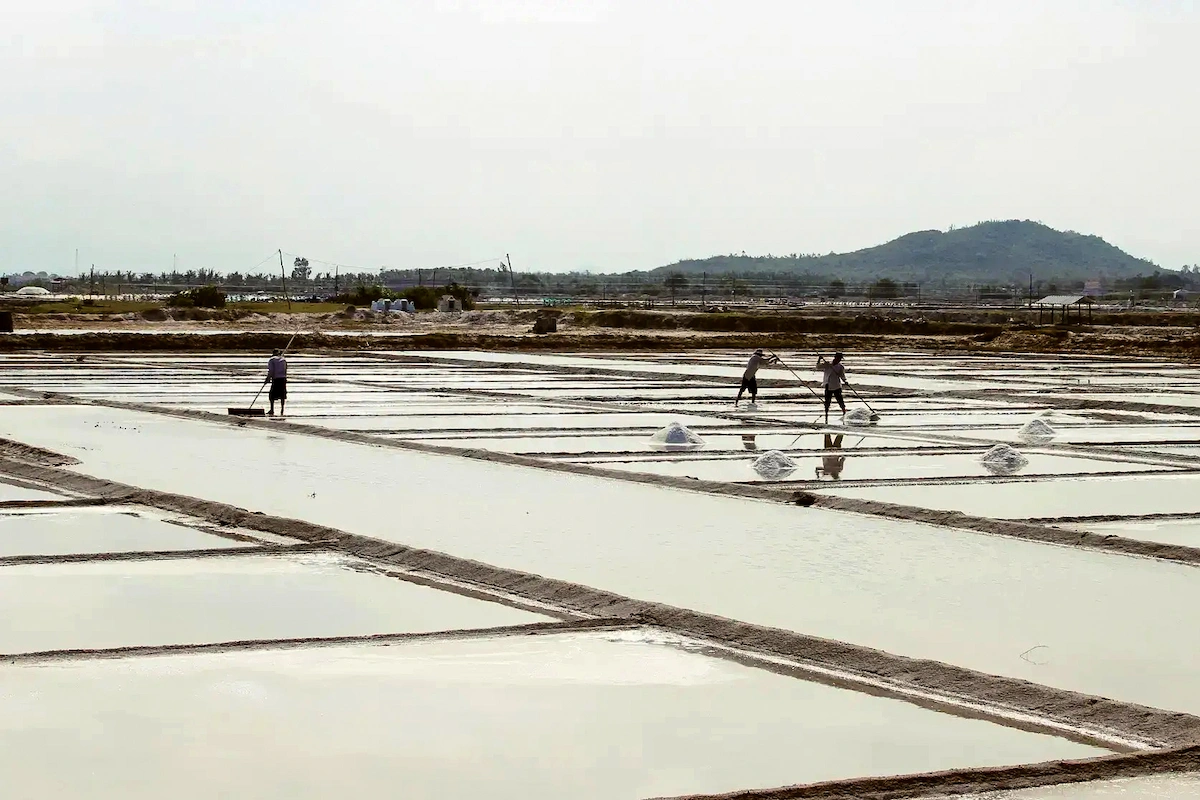
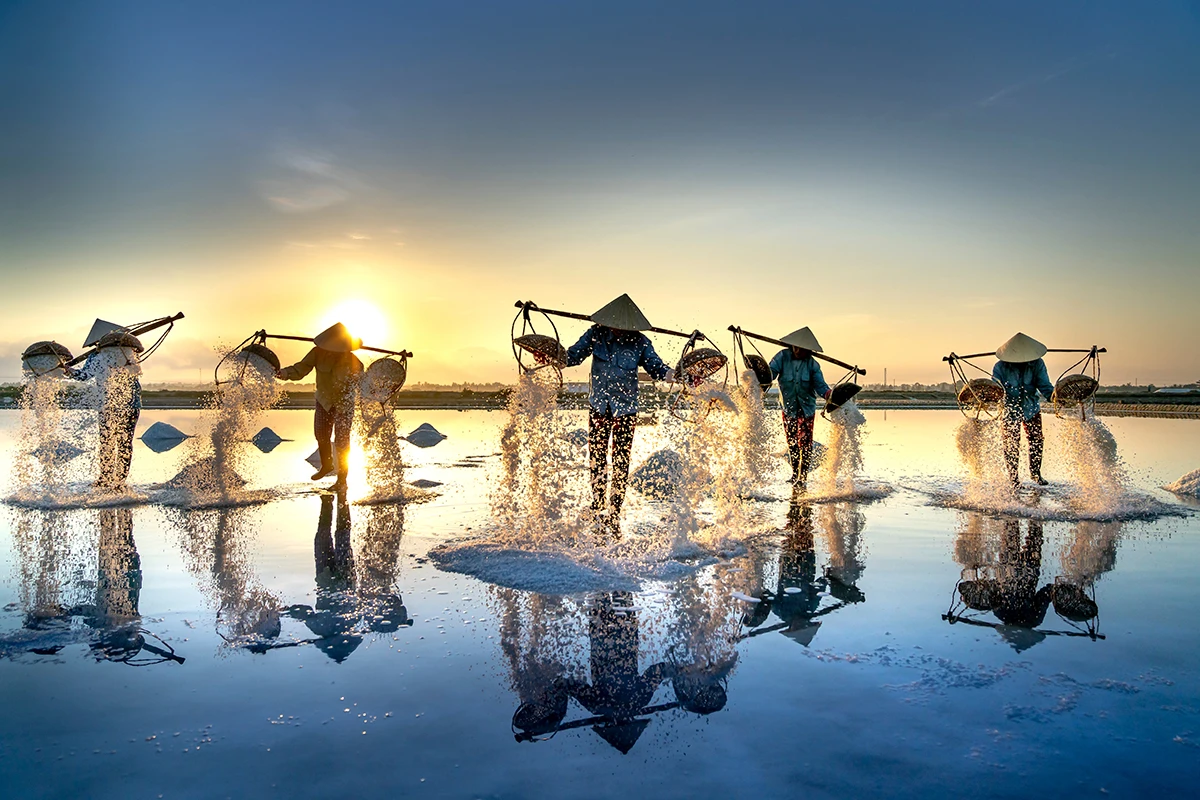
On a sunny day, the fields can become an extraordinary visual landscape. Geometric plots reflect the sky, small piles of harvested salt appear brilliantly white against the darker soil, and workers move steadily between the fields. For photographers, the combination of repetitive patterns, human movement, strong sunlight, and enormous open skies creates a distinctive subject that is very different from the limestone scenery of inland Ninh Binh.
But it is important not to romanticize the work. Salt farming is physically demanding. Farmers spend long hours outdoors under intense sunlight, often performing repetitive manual tasks. The beauty visitors see in photographs comes from a working landscape created through considerable effort.
Travel with respect
The best photographs are not always the closest ones. Ask before photographing people, avoid walking across active salt plots, and never interfere with tools, water channels, sand beds, or harvested salt. Remember that this is a workplace first and a tourist attraction second.
A Working Coastal Landscape, Not Just a Tourist Attraction
Bach Long salt field is more than a place where salt is produced. It is part of a wider coastal landscape shaped by seawater, tides, farming, fishing, and traditional livelihoods. For travelers, this makes the salt fields particularly valuable: the landscape tells a story about how people have adapted their lives to the coast over generations.
That broader context is what makes a visit here different from a conventional sightseeing stop. You are not simply looking at rows of white salt. You are seeing a working environment where weather determines the rhythm of the day, where traditional knowledge still matters, and where the future of a centuries-old occupation remains closely connected to the local community.
What makes the experience different?
At Bach Long, there is no single monument to photograph and no checklist of attractions to complete. The experience comes from watching a traditional craft, meeting the people who keep it alive, and seeing how closely local life depends on the coastal environment.
That is precisely why this modest-looking landscape deserves attention from travelers seeking a more authentic side of Vietnam. The salt fields reveal a culture of patience and resilience that cannot be understood from a guidebook alone.
Visiting Bach Long Salt Field: What Travelers Should Know
Understanding how salt is made is only part of the experience. To truly appreciate Bach Long salt field, travelers need to see the work at the right time, respect the people who depend on it, and understand why this traditional landscape matters. A visit is not simply an opportunity to photograph white salt crystals. It is a chance to step into a working coastal environment where weather, water, labor, and local knowledge have shaped everyday life for generations.
When is the best time to see salt production?
The traditional salt-making season at Bach Long generally runs from March to August, although actual working days depend heavily on weather conditions. Strong sunshine is essential because evaporation drives the entire process. Clear, hot days therefore provide the best opportunity to see the fields in active production.
For photographers, early morning and late afternoon can provide the most attractive light. In the morning, the fields can appear cool and silvery, while later in the day the low sunlight creates long shadows across the geometric salt plots. During periods of intense production, visitors may also see farmers collecting salt, moving sand, transporting materials, or preparing the next stage of the process.
Best time to visit Bach Long
| Main salt season | Approximately March–August |
| Best weather | Sunny, dry periods |
| Best for photography | Early morning or late afternoon |
| What can change? | Daily production depends on sunshine, rain and local working conditions |
Do not expect a staged tourist experience
One of the attractions of Bach Long salt field is precisely the absence of a highly staged tourism environment. Farmers come to work because they have a job to do, not because visitors have arrived. Their routines continue whether a camera is present or not.
This creates an important difference between observing a traditional occupation and attending a cultural performance. Travelers may see people pushing carts, spreading sand, directing seawater, raking salt-laden sand, filtering brine, or gathering finished salt. The sequence may look simple from a distance, but watching it closely reveals just how much physical effort is involved.
Travelers should therefore allow the experience to unfold naturally. A short conversation with a farmer, through a local guide when necessary, can be more rewarding than trying to photograph every stage of the process.
Photography etiquette: Always ask permission before taking close-up portraits. Stay on appropriate paths, avoid stepping into active salt plots, and do not touch tools, sand beds, brine, or harvested salt unless a local farmer specifically invites you to do so.
Why traditional salt farming still matters
The future of salt farming in Vietnam faces real challenges. Traditional production is labor-intensive, weather-dependent, and generally less competitive than more mechanized or industrial methods. In coastal communities, younger generations may also have opportunities to find work outside agriculture, making it harder to maintain an occupation that demands long hours under intense sunlight.
Yet traditional salt fields have values that cannot be measured only by the price of salt. They preserve local knowledge, maintain a distinctive cultural landscape, and provide a direct link between coastal ecosystems and human livelihoods.
The Vietnamese government has also identified traditional salt-making villages, including Bach Long, as potential locations for models that combine salt production with tourism. Such approaches aim to increase the value of traditional products while creating additional income opportunities for local communities.
For this reason, responsible tourism can have a practical role. Buying locally produced salt or other community products, using locally operated services, and paying fairly for guided experiences can help ensure that visitors contribute to the people whose work makes the destination worth visiting in the first place.
Bach Long and Xuan Thuy: Two Experiences in One Coastal Journey
Bach Long salt field becomes even more interesting when combined with nearby Xuan Thuy National Park. Located in the same coastal region, the two destinations offer two very different ways to understand northern Vietnam’s relationship with the sea: one through traditional salt making, the other through wetlands, mangroves, migratory birds, and coastal biodiversity.
For travelers with a full day to explore the area, combining the two can create a much richer experience than visiting either place alone. Start at Bach Long to see how local families turn seawater, sand, sunlight, and hard work into salt. Then continue to the wetland environment of Xuan Thuy to discover the natural systems that support coastal life, including tidal mudflats, mangrove forests, and important bird habitats.
A simple coastal day: Salt & Wetlands
Morning: Explore the working salt fields of Bach Long and learn about traditional salt production.
Midday: Enjoy a local meal in the surrounding coastal countryside.
Afternoon: Continue toward Xuan Thuy National Park for a different perspective on the region’s wetlands and wildlife, subject to current access and activity conditions.
The combination is especially appealing to visitors interested in slow travel, nature, photography, local culture, and community-based tourism. One destination tells the story of how people have learned to work with the sea; the other shows why the coastal ecosystem itself is worth protecting. Together, they reveal a side of Ninh Binh that most visitors never see.
Travelers planning a wider journey can also explore our Ninh Binh Travel Guide for more ideas on combining the province’s cultural heritage, rural landscapes, nature experiences, and emerging coastal destinations.
A “Sea to Table” perspective
Salt is one of the simplest ingredients in a meal, but Bach Long reveals the journey behind it: seawater → sand → sunlight → labor → salt. Seeing that process can turn an ordinary ingredient into a story about people and place.
What could the future look like?
The future of Bach Long does not necessarily have to mean turning the entire salt field into a conventional tourist attraction. A more sustainable direction would be to keep salt production at the heart of the landscape while allowing visitors to participate in carefully managed cultural and educational experiences.
Possible experiences could include guided walks through the working fields, demonstrations of traditional sand-drying techniques, conversations with salt farmers, local cooking experiences using Bach Long salt, photography walks, and visits combined with nearby wetlands and villages. The goal should be to create additional value for the community without replacing the traditional activity that gives the destination its identity.
This approach would also fit naturally with the wider development of rural and community tourism in northern Vietnam. Official tourism programs have already identified Bach Long as one of the traditional craft communities with potential for community participation and tourism development.
Why travelers should visit now
There is a compelling reason to discover Bach Long salt field before it becomes widely known internationally. Its appeal does not come from a spectacular monument or a famous viewpoint. It comes from authenticity: real people doing real work in a landscape shaped by the sea.
For visitors accustomed to northern Vietnam’s famous limestone mountains, boat trips, and historic temples, Bach Long offers a completely different perspective. Here, the scenery is horizontal rather than vertical. The drama comes from sunlight, clouds, tides, human movement, and the changing surface of the fields.
Most importantly, a visit can remind travelers that destinations are created not only by natural beauty or historic buildings, but also by the people who have spent generations making a living from the land around them.
More Than a Salt Field
Bach Long is a story of sun, seawater, sand and human perseverance. For travelers seeking meaningful experiences beyond Vietnam’s usual highlights, spending time with the people who continue this traditional craft can be one of the most memorable ways to discover the country’s northern coast.
Practical note: Salt production is seasonal and highly dependent on weather. Before visiting, confirm current local conditions and whether community-based experiences are operating. The most respectful visit is one that fits around the farmers’ working routines rather than disrupting them.